Introduction
The success of any business relies mainly on its customers and on how much they value its products.
However, it’s not always the case that a business gets it right the first time when delivering products to customers.
Data Science is one way to ensure that customer feedback is incorporated into a business’s product or service delivery.
This is where sentiment analysis comes in: large amounts of data are generated by collecting feedback, comments, and posts that mention a given product. A business collects this data to understand customers’ opinions. Sentiment analysis results from machine learning or text analysis can guide a business in making the right changes or addressing issues related to product or service delivery.
What Is Sentiment Analysis?
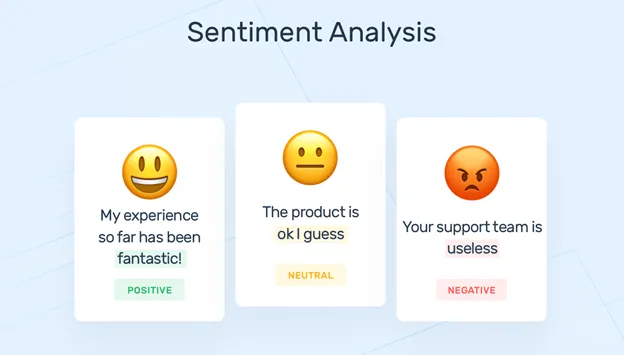
Sentiment analysis helps the business categorize or understand the customer’s emotions towards the products or services the business delivers. Simply put, sentiment analysis provides a polarity score indicating how customers feel about a given aspect of the business being tested. In some cases, sentiment analysis is known as opinion mining.
Most sentiment analysis is done on feedback collected about a business, its social media engagement, or its campaigns. Businesses can run campaigns to collect user feedback on social media and later analyze the data to understand the sentiments behind it.
Steps in sentiment analysis
Like any other data-related project, sentiment analysis follows the data analysis and machine learning process. The first steps are data collection. With most of the data coming from either feedback or social media campaign data, data scraping is the best approach to getting the necessary data for sentiment analysis. Data scraping can use any tool that enables it. Using their API is the best way to get the necessary data for social media platforms such as Twitter. Twitter tweepy API is a good place to start.
The next step is data preprocessing. In sentiment analysis, data preprocessing includes tokenization, vectorization, and text preprocessing. Tools such as NLTK are essential at this stage and help you perform preprocessing tasks easily. Activities involved in this stage include removing stop words and lemmatizing the data.
At this stage, you can use the resulting data to visualize a word cloud showing the most frequent words and gain insights into what people are talking about regarding your product. It is also a good place to see some adjectives that customers use to describe your product.
The last step is to model the machine learning model using logistic regressions, Naïve Bayes, or support vector machines. Sentiment analysis is a classification problem. Once this is done, you can visualize the results and determine what polarity most of the communication or texts fall on as it relates to the product.
Note: You can use real-time streaming data to score incoming texts by polarity and plot a graph showing how sentiment on your product is trending throughout the period. Streaming your social media account data helps you have a real-time view of your customers’ sentiments about your brand or product.
Best Practices For Sentiment Analysis
When performing sentiment analysis, you can either build your own tool or purchase a tool to do the sentiment analysis. The best option for a tech-savvy business is to build its own tools and use them to gauge sentiment; however, if you don’t have the right team, purchasing SaaS sentiment analysis tools might be the only available alternative.
These out-of-the-box tools can be integrated with other tools, such as CRMs. However, having an in-house team that builds the tools or models for sentiment analysis gives you full control over the activities and the data you want analyzed.
Most popular application areas for sentiment analysis
Data is constantly growing, and businesses need to keep up. The most popular application of sentiment analysis is to analyze unstructured, large-scale company data. Understanding unstructured data requires the business to use machine learning to categorize it.
One of these categorizations is on customer data’s sentiments or polarity. By polarity, I mean where the feedback or review is positive, negative, or neutral. Sentiment analysis also provides a score on either side of the polarity extent. While understanding the data in its raw form is challenging, categorizing it by polarity is simpler and more actionable.
Social media is a tool for growth and a weapon against failures in business services. Today, when a business does something wrong, almost everyone runs to social media to criticize it. The same happens when your delivery does not arrive on time, and you rush to Twitter to tweet about it. Sentiment analysis helps businesses take swift action on customer complaints on social media by gauging the experience.

Similarly, when a business needs to establish a competitive advantage, understanding market or customer sentiment is essential. Sentiment analysis can also help predict what future customers will do and the overall customer trend for a given item or product.
Sentiment analysis of products or a business significantly improves business intelligence. Insights into sentiment and unique words that describe a product or business help the business make the right decisions when strategizing and addressing issues it might face.
The insights can also give the business the right ideas for targeting a market demographic. An example is when a product is reviewed positively by a given demographic group A, while a different group, B, has a negative sentiment toward the product. The business can easily identify the issue raised by group B and address it to win that demographic group as a market.
Challenges in sentiment analysis.
Anyone who has been involved in social media campaigns knows that to increase a post’s visibility, some campaigners use trending keywords, thereby increasing not just their visibility but that of the product in question. This is beneficial in that more people will learn about the product.
However, the posts that will come up in the product's trend will not be related to the product. This is a major issue in the sentiment analysis of social media data. Most of the data can be perceived to be similar to Dark data. The dark data is collected from the campaign but has nothing to do with the actual campaign or product, and therefore, it will affect the sentiment analysis results.