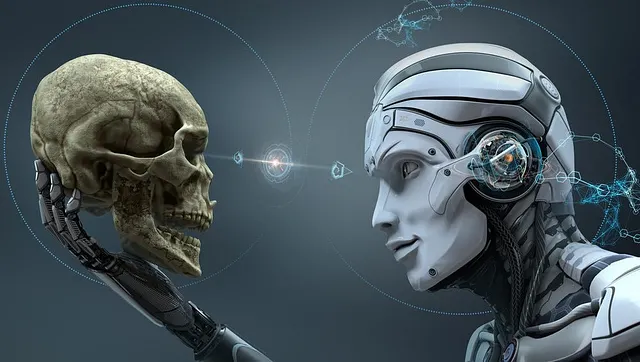
Before we continue with systemic risks, let’s look at something I read.
In his book Scary Smart, Mo Gawdat asks readers to imagine sitting by a campfire in the wilderness in 2055, 99 years after the AI story began in 1956. In the imagined scenario, the story of AI has led us to the middle of nowhere. The question that lingers as you start reading the book is, are we in the wilderness, escaping the machines, or enjoying how efficient AI has been in making life (in the wilderness) better? Anyone who has watched an AI apocalypse movie will jump to the idea that we are in the wilderness, escaping the machines! But this could be wrong; what if we managed to build an AI that was safe? What if our governance efforts make AI precisely what the world needs to solve the existing challenges?
Systemic risks
When discussing systemic risks, they are risks beyond those posed by the capabilities of available general-purpose AI systems. The widespread deployment of these AI systems is associated with systemic risks that span labor markets, privacy, and the environment. The continuous expansion and advancement of general-purpose AI poses a risk to labor markets due to its capabilities to automate a wide variety of tasks. People previously handled these tasks, and the ongoing advancement of AI systems in perfecting them poses a significant disruption to the labor market. However, there is a different school of thought that suggests job losses could be offset by the creation of new jobs in non-automated sectors.
A second risk is the Global AI research and development divide. In the current AI research and development, there is a focus on the countries doing this. It is in a few Western countries and China. This increases the case of the AI divide, which could further expand as dependence on this small set of countries grows. This is likely to contribute to global inequality as well. Low- and middle-income countries may feel this divide further as AI advances, given their limited access to the expensive computing power needed to develop general-purpose AI.
There is a high market concentration in a small number of companies' AI systems, posing a single-point-of-failure risk. Today, there are countless AI systems in mainstream use, accessible to most people worldwide. As a result, a single bug in any of these could cause a worldwide risk. If organizations across sensitive and critical sectors rely on these small number of available general-purpose AI systems, a single vulnerability would affect all of them and cause simultaneous failures or disruptions.
Increased use of energy, water, and raw materials is an AI advance, and a growth in computing use in general-purpose AI development is witnessed. To set up the necessary infrastructure, these environmental resources are being used on a large scale, which poses a risk to the already dilapidated environment today. We all agree that there is progress in efficiency techniques that would enable computing to be used more effectively. However, this is still not mainstream or significant enough to offset the resources consumed in computing.
The conversation about privacy risk has been heard many times. It’s not just the AI sector, but also other data-related sectors. General-purpose AI development uses massive data sets to train. This increases the likelihood that this data will be exposed in responses or maliciously used to cause or contribute to a breach of privacy. General-purpose AI can also be used to infer sensitive and private information from large datasets. This issue is also a potential risk since we still don’t have enough data on widespread privacy violations.
Recently, AI processes realized that taking a second or two before responding to a request can help break it down into simpler, smaller tasks, and voila, a long chain of thought was born!