In a modern Data Mesh, where data is treated as a first-class product, versioning is not just a technical luxury; it is the backbone of operational reliability. To move from a disorganized “data junkpile” to a scalable ecosystem, organizations must treat their data schemas with the same discipline as software APIs.
Navigating the Complex World of Data Product Versioning
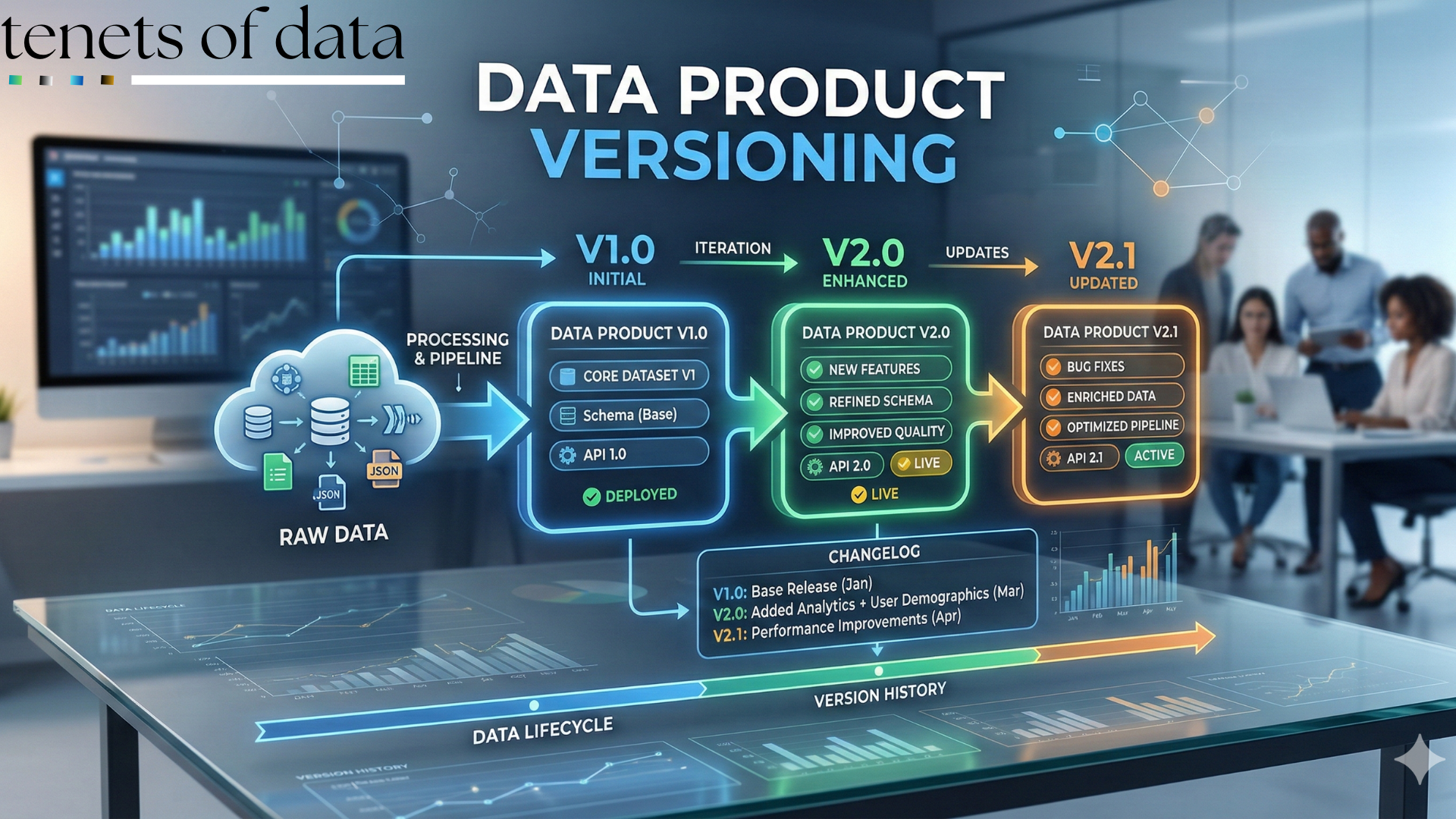
Introduction
Imagine this: an engineering team renames a database column from user_id to customer_id for better clarity. It is a minor, positive change. However, twelve hours later, five executive dashboards are showing blank values, two machine learning pipelines have crashed, and your data engineering team is deep-diving into a data emergency that could have been entirely prevented. This scenario is the hallmark of a lack of data product versioning, a systematic approach to tracking and managing modifications to datasets, models, and schemas over time.
In a modern Data Mesh, where data is treated as a first-class product, versioning is the backbone of operational reliability. To move from a disorganized data mess to a scalable ecosystem, organizations must treat their data schemas with the same discipline as software APIs.
What is Data Product Versioning?
Data product versioning is the process of assigning distinct identifiers or labels to diverse iterations of a data product. Much like software versioning, it allows teams to distinguish between different data snapshots, ensuring that consumers always know which active agreement they are using. In a functional data mesh, this involves versioning not just the raw data, but also the transformation code, metadata, access policies, and the underlying infrastructure.
One of the most effective ways to manage this is through Semantic Versioning (SemVer). Under this framework, updates are categorized by their impact:
- Patches (X.X.1): Internal bug fixes or performance optimizations that do not change the data’s structure.
- Minor Updates (X.1.0): Additive, backward-compatible changes, such as adding a new optional column or descriptive metadata.
- Major Updates (1.0.0): Breaking changes that require consumer action, such as removing columns, changing data types, or altering the semantic definition of a metric (e.g., changing revenue from gross to net).
Why Versioning Matters
The primary driver for versioning is the preservation of trust. In an interconnected web of data products, one product’s output is often another’s input. Without coordinated versioning, a single change can trigger a cascading failure, where errors snowball through the system and cause unexpected behavior in products far removed from the original modification.
1. Reproducibility and Debugging
In machine learning, a model is only as good as the data it was trained on. Data versioning allows practitioners to link specific model iterations to exact dataset versions. This ensures that experiments can be rerun under identical conditions to validate results or identify whether a drop in accuracy was caused by a code change or a shift in the underlying data.
2. Handling Model Drift
Statistical properties of data change over time, a phenomenon known as model drift. Versioning helps teams identify these patterns by tracing changes across historical iterations, enabling them to retrain models using the most relevant data distribution.
3. Compliance and Auditability
For regulated industries (e.g., healthcare or finance), maintaining an audit trail of how a dataset evolved is mandatory for compliance with laws like KDPA, GDPR, or HIPAA. Versioning provides a transparent history of “who changed what and when,” which is critical during regulatory audits.
Tools and Implementation
The industry has moved beyond ad hoc file naming conventions such as dataset_v2_final_FINAL(2).csv. Modern teams now employ two primary worldviews for data version control:
- Git-integrated Tooling (e.g., DVC): This approach tracks tiny metafiles (pointers) in Git while storing the large artifacts (datasets, models) in remote storage, such as S3. It is ideal for model-centric teams that want code and data provenance to live side-by-side.
- Storage-native Layers (e.g., lakeFS): These tools turn your object store into a versioned filesystem. They allow teams to create branches of a 200 TB dataset in seconds, run experiments in isolation, and merge them back without physically copying the data.
- Time Travel and Cloning: Platforms like Snowflake offer built-in Time Travel to query data at specific past timestamps and Cloning to create instant, identical copies of tables for testing.
Challenges Encountered in the Process
Despite the benefits, implementing a robust versioning strategy most times has challenges:
- The Transformation Tax: Large-scale migrations or the adoption of rigorous versioning can introduce hidden costs. Research shows that many organizations suffer from migration fatigue and a drop in developer morale when the rip-and-replace of old systems doesn’t deliver immediate ROI.
- Storage and Complexity: Versioning large, dynamic datasets can drive up storage demands and associated costs if not managed with incremental versioning or compression.
- Dependency Spaghetti: In large enterprises, domain teams may not even know who is consuming their data. Renaming a metric in the Finance domain might break a Marketing report that the Finance team didn’t know existed.
- Cultural Shift: Encouraging teams to adopt product thinking and take accountability for versioning their outputs requires a significant cultural change. Data producers often view data as a byproduct of their primary role, not a product that requires active management.
Best Practices for a Resilient Strategy
To avoid data anarchy, organizations should follow a disciplined path:
Adopt an Additive-Only Pattern: Whenever possible, avoid renaming or removing columns. Instead, add the new column alongside the old one, populate both, and migrate consumers slowly. Only after a grace period (e.g., 90 days) should the old column be removed.
- Formalize Data Contracts: Treat the schema as an enforceable agreement. Use machine-readable contracts to validate data at the ingestion point, catching breaking changes before they hit production.
- Unified Cataloging: Each version of a data product should be cataloged separately, highlighting what changed between versions so consumers can make informed decisions.
- Parallel Releases: Allow new and old versions to coexist during a transition window. This gives downstream consumers the time they need to adapt their queries without emergency downtime.
Conclusion
Data product versioning is the difference between a fragile data swamp and a high-performance data engine. By embracing semantic standards, leveraging automated tools like lakeFS or DVC, and maintaining clear communication across domains, organizations can build a resilient ecosystem where innovation doesn’t have to come at the cost of stability. As data continues to scale, the ability to step in the same river twice, to find and rely on a specific, stable state of information, will remain the ultimate competitive advantage.