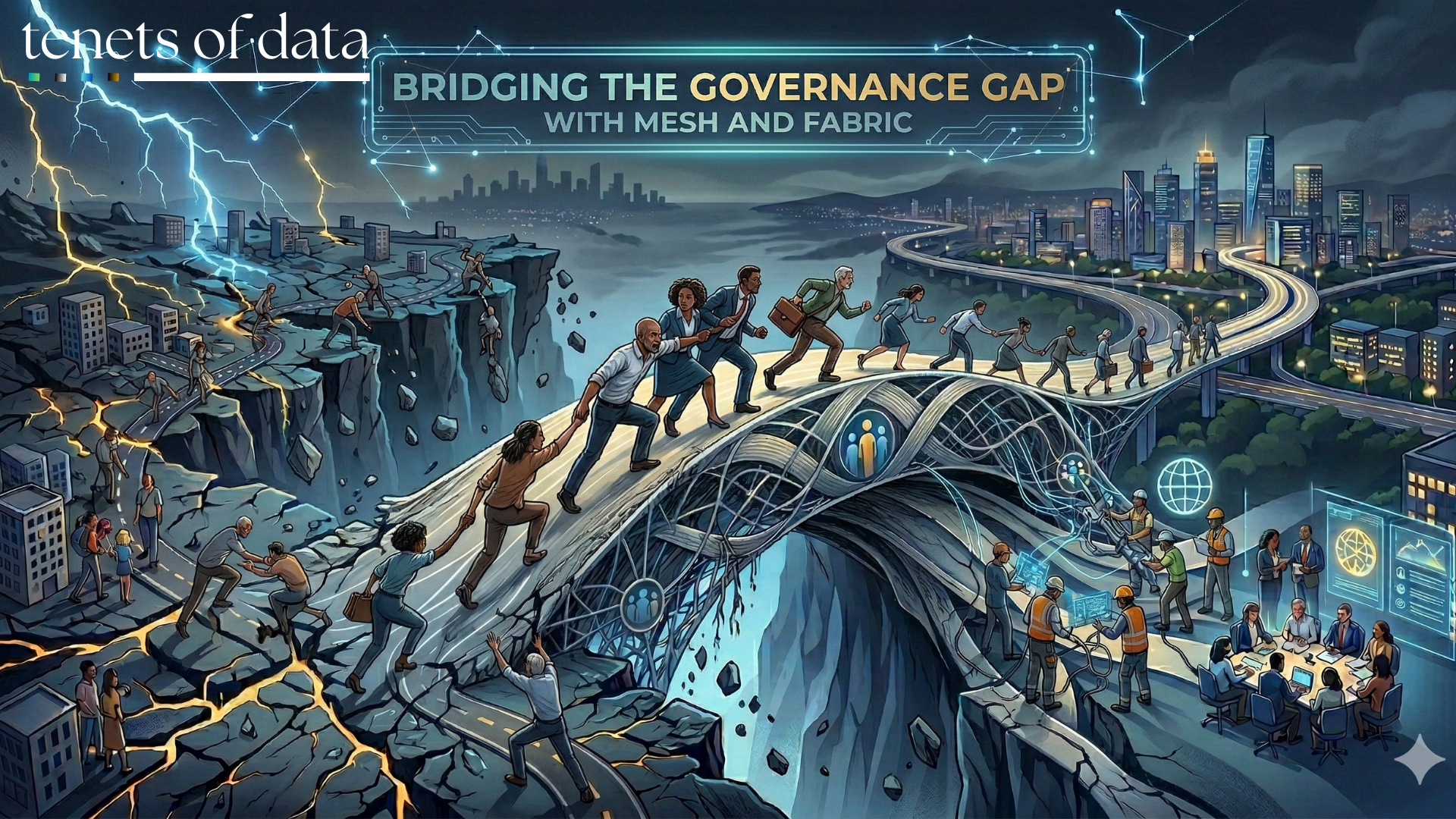
Introduction
It isn't uncommon in some organizations for definitions to be confusing, especially data definitions for different teams. I believe we’ve all lived through that Monday morning meeting where Revenue becomes a debate rather than a metric. The Sales lead presents one number, Finance counters with another, and by noon, your best analysts are trapped in a reconciliation loop, trying to untangle undocumented pipelines just to find the truth. This is a good example of a context debt that most organizations suffer from: the data exists, but it either barely represents the truth or no one can understand it. Their landscapes have become data junkpiles of disconnected tables, undocumented pipelines, and dark data that consume storage resources without generating a single cent in return.
To move from this state of analytical chaos to a high-performance ecosystem, we must address these critical data pathologies by leveraging the dual powers of Data Mesh and Data Fabric.
Common Data issues in Organziations
1. Accountability on Paper vs. In Practice
In many traditional architectures, data ownership is a paper tiger i.e it is a formal designation that defaults to a central IT team removed from the business context. These central teams are often treated like plumbers rather than partners, tasked with managing datasets they do not fundamentally understand. This lack of clear, contextual ownership is why bad data costs organizations large sums of money annually.
The Solution
Data Mesh inverts this model through domain-oriented decentralized ownership. It shifts responsibility to the subject-matter experts, Sales, Finance, or Marketing, who have deep knowledge of their source systems. By treating data as a product, these teams become truly accountable for its quality, documentation, and user satisfaction.
2. Definition Drift
Definition drift (or semantic misalignment) occurs when different departments use the same term to refer to conflicting concepts. For example, the active user problem: Marketing might define it as a login, while Product sees it as a specific feature usage, and Finance counts it as a successful payment. This lack of transparency forces business leaders to spend more time debating data than acting on it.
The Solution
A Data Fabric provides the technological connection by using active metadata and AI to discover relationships across fragmented systems. It acts as a Universal Translator, creating a conceptual bridge between technical implementation and business meaning. Meanwhile, every data product includes Semantic Logic within its Product Wrapper a set of definitions that ensures everyone is speaking the same data language.
3. Untracked Lineage
When a pipeline fails, the impact often snowballs into a cascading failure, breaking downstream reports and AI models without warning. Because lineage is often untracked or manual, employees waste between 3.6 and 4.2 hours per day just searching for relevant information and trying to understand its provenance.
The Solution
Modern data products utilize automated lineage tracking (often via a Data Fabric or catalog) to map every dependency from source to consumption. This visibility turns panicked Slack messages into proactive updates, allowing teams to conduct root-cause analysis in seconds rather than days.
4. Data Silos
Data silos emerge organically through departmental specialization and historical acquisition patterns, trapping information in incompatible formats. These isolated islands generate massive operational costs, including duplicate data entry and inconsistent reporting. Silos isolate vital integration points and curtail strategic synergy, making the organization slower and vulnerable to miscommunication.
The Solution
A Data Mesh breaks down these silos by empowering domain teams to share data via formal, standardized interfaces. Data Fabric complements this by allowing for zero-copy integration, providing a unified view of data without physically moving it into a single monolithic repository.
5. Data Downtime
Data downtime refers to periods when data is missing, stale, or erroneous, i.e unusable. For many, these issues are "consumers notice" that fly under the radar until consumers notice the numbers. This can lead to financial losses when they go unnoticed for long.
The Solution
Transitioning to data observability allows teams to catch issues before they reach stakeholders. By integrating observability as a product feature, data producers can use automated monitoring of freshness, volume, and distribution to detect anomalies in real-time.
6. Dark Data
Over 50-80% of enterprise data is unutilized dark data information that is collected and stored but never used to generate business value. This data generates no income but incurs significant storage and computing costs, acting as a tax on your innovation budget.
The Solution
Treating data as a product requires a clear focus on usefulness. Data Product Managers (DPMs) act as the CEOs of their domain, conducting user research to ensure that only high-value, reusable datasets are maintained and promoted.
How Mesh and Fabric Power the Data Product
While often viewed as competing paradigms, Data Mesh provides the organizational framework, while Data Fabric provides the technological automation.
- Data Mesh empowers autonomous teams to build **Data Products **reusable, active, and standardized assets that bundle data with the code and metadata needed to function.
- Data Fabric acts as a virtual management layer, using machine learning to automate discovery, integration, and governance across these products, regardless of whether they live on-premises or in a multi-cloud environment.
Conclusion
When you treat data as a product rather than a byproduct, it stops behaving like a swamp and starts behaving like infrastructure you can actually build a business on.