Introduction
Artificial intelligence (AI) is no longer a peripheral experiment but a core driver of competitive advantage and industrial revolution. As organizations race to integrate these technologies, they face a critical transition: moving from vague ethical aspirations to structured, enforceable governance. Effective AI governance provides a standardized framework for managing AI risks, ensuring that innovation does not come at the cost of safety, fairness, or legal integrity.
Defining AI Governance: From Ethics to Enforceable Guardrails
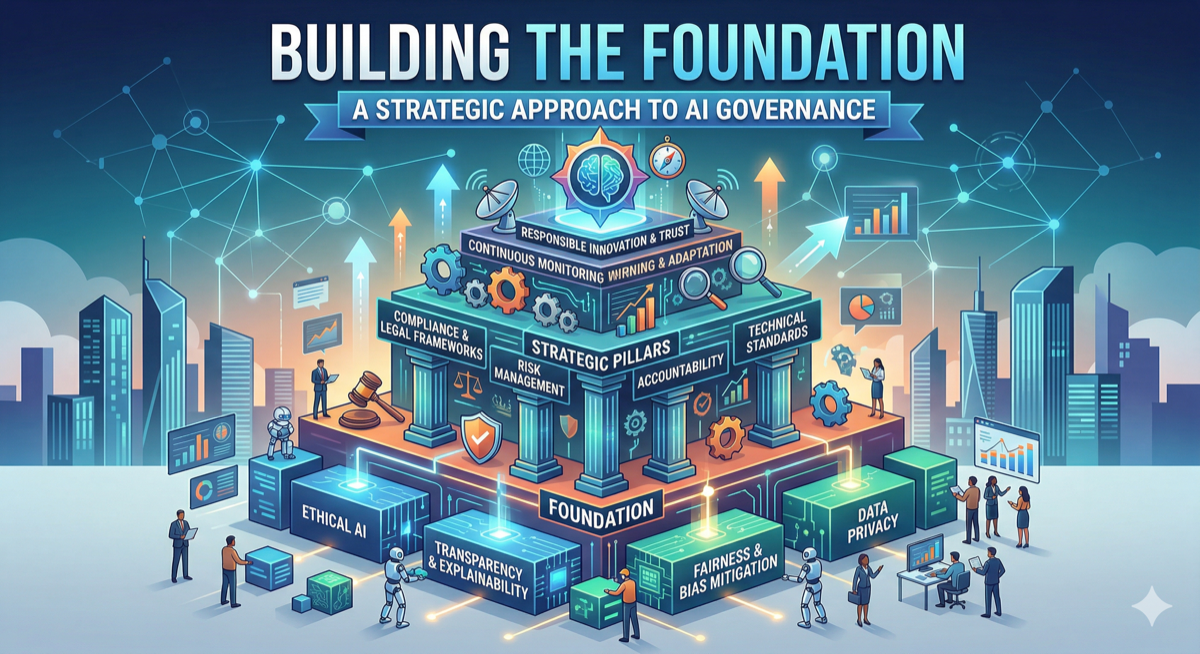
AI governance refers to the processes, standards, and guardrails that ensure AI systems are safe, ethical, and aligned with organizational values. While early discussions focused on broad "ethical principles," modern strategy requires an **AI Management System (AIMS)**—a structured framework for responsible oversight.
Strategic governance moves beyond theory by implementing:
- Enforceable Guardrails: Standards like ISO/IEC 42001 and the NIST AI Risk Management Framework (RMF) provide requirements for implementing, maintaining, and improving AI systems.
- Trustworthiness as a Standard: AIMS mandates that security, safety, fairness, transparency, and data quality are integrated into every stage of the AI lifecycle.
- Automated Oversight: Moving away from manual audits toward real-time monitoring and technical controls that can detect model drift or bias before they cause harm.
The Risk-Based Approach: Impact Categorization
Strategic alignment requires a risk-based approach, which calibrates governance intensity to the level of impact an AI system may have on individuals and society. This model, pioneered by the EU AI Act, categorizes systems into four distinct tiers:
- Unacceptable Risk (Prohibited): Systems deemed a clear threat to safety or fundamental rights are banned. This includes AI used for social scoring, untargeted facial image scraping, or manipulative behavioral techniques.
- High-Risk: Applications with significant impacts on health, safety, or fundamental rights (e.g., healthcare diagnostics, recruitment, or critical infrastructure management). These require rigorous conformity assessments, post-market monitoring, and strict data quality standards.
- Limited Risk (Transparency Risk): Systems like chatbots or deepfakes that pose risks of impersonation or deception. These must meet specific transparency obligations, such as disclosing to users that they are interacting with AI.
- Minimal Risk: The majority of AI applications, such as spam filters or video games, fall into this category. These systems are not subject to additional legal obligations, though voluntary codes of conduct are encouraged.
Business Value: Innovation Through Friction Reduction
Far from being a bottleneck, robust governance is a competitive necessity that accelerates innovation by reducing the "friction" caused by legal and reputational risks.
- Agility and Responsive Growth: Effective governance allows organizations to be more innovative and responsive to market changes by identifying risks early in the development cycle.
- Resource Optimization: An AIMS assists in better resource allocation—workforce, time, and finances—by proactively identifying areas where AI can lead to optimized processes.
- Market Trust and Adoption: Trust is a major roadblock to AI adoption; 80% of business leaders cite explainability and ethics as primary hurdles. Clear governance builds the transparency necessary to win stakeholder and customer confidence.
- Regulatory Resilience: Adopting recognized frameworks like NIST RMF or ISO 42001 positions organizations to comply with emerging global regulations, preventing costly retrospective overhauls.
Stakeholder Mapping: The Governance Table
AI governance is a collective responsibility that requires a multidisciplinary team to bridge the gap between technical execution and strategic oversight.
- The Board of Directors: Responsible for strategic oversight and fulfilling fiduciary duties regarding AI risk and opportunity.
- C-Suite Leadership: The CEO sets the tone and culture for responsible AI use. The **Chief AI Officer (CAIO)**—a new emerging role—operates at the intersection of tech, ethics, and business transformation.
- Legal and General Counsel: Critical for assessing legal exposure, ensuring compliance with evolving regulations like the EU AI Act, and managing intellectual property risks.
- IT and Information Security (CISO): Tasked with addressing AI-specific security vulnerabilities, such as data poisoning or adversarial attacks, and integrating AI into the broader cybersecurity strategy.
- Data Science and ML Engineering: Responsible for the technical implementation of risk mitigation, ensuring data quality, and conducting model evaluations/red-teaming.
Conclusion: Embedding Governance into Core Strategy
Building an AI governance foundation is not a one-time project but an iterative lifecycle process. Organizations must move from reactive firefighting to transformative leadership by embedding AI oversight into their core duties, ensuring that every deployment is not just technologically advanced, but strategically sound and ethically responsible.