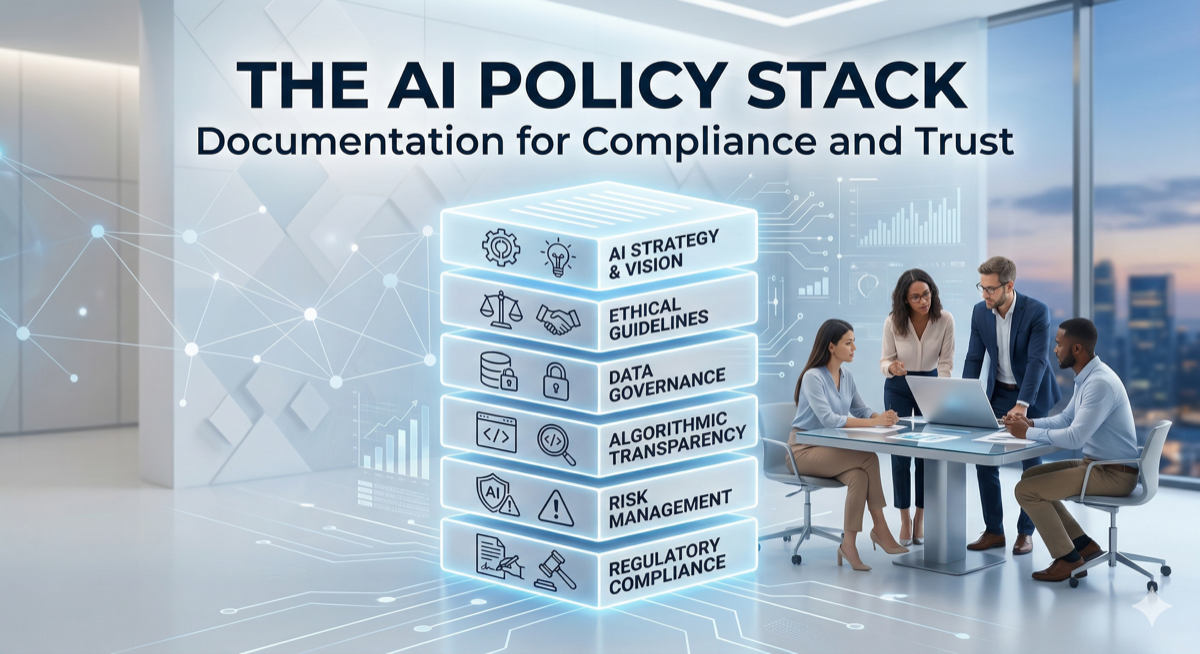
The AI Policy Stack: Documentation for Compliance and Trust
In the modern regulatory environment, AI governance must transition from abstract values to a concrete "paper trail" of accountability. A robust documentation stack serves as an organization’s internal rulebook, ensuring that AI systems are safe, ethical, and legally defensible. Documentation not only facilitates compliance with standards like ISO/IEC 42001 and the EU AI Act but also builds the necessary trust for stakeholder adoption.
1. Acceptable Use Policy (AUP): Internal Rules for Generative AI
The AUP establishes the guardrails for employees interacting with third-party or publicly available Generative AI (GenAI) tools to prevent security breaches and intellectual property loss.
- Human-in-the-Loop Requirement: AI tools are not a substitute for human judgment; all outputs must be carefully verified by a human for accuracy and potential "hallucinations" before being used in work products.
- Data Input Prohibitions: Employees must never upload confidential, proprietary, or sensitive company information, such as passwords, personnel records, or trade secrets, into public AI tools.
- Privacy Protections: The input of personally identifiable information (PII) about any person is strictly prohibited to avoid breaching privacy obligations.
- Prohibited Decisions: GenAI tools must not be used to make or assist in employment decisions, including hiring, promotions, or discipline, to avoid automated bias.
- Mandatory Disclosure: Employees are required to inform supervisors when AI tools have assisted in a task and must never represent machine-generated work as their original creation.
2. Model Development Policy: Standards for Data and Design
For organizations developing their own models or fine-tuning existing ones, a Model Development Policy ensures data integrity and scientific rigor.
- Data Sourcing and Quality: Datasets must be relevant, representative, and free of errors to the best extent possible. Developers should avoid using data from untrusted third-party brokers and prioritize data collected according to privacy-by-design rules.
- Annotation and Labeling: Clear standards for data preparation, including annotation and cleaning, must be documented to minimize computational bias.
- Synthetic Data and Marking: When using synthetic content, developers must implement technical marking (e.g., watermarks) in a machine-readable format to ensure the origin can be detected.
- Data Provenance and Lineage: Organizations must maintain a provenance record that tracks where data originated, how it was moved, and how its accuracy is maintained over time.
3. Incident Response Plan: Protocols for AI Failure
An AI-specific Incident Response Plan is critical for addressing hallucinations, security breaches, or system malfunctions that lead to harm.
- Defining Serious Incidents: Protocols must be triggered by "serious incidents," defined as those leading to death, serious harm to health, or irreversible disruption of critical infrastructure.
- Reporting Timelines: In alignment with the EU AI Act, serious incidents must be documented and reported to relevant authorities no later than 10 days after the provider becomes aware of the event.
- Containment and Remediation: The plan should include the use of "kill switches" or stop buttons to halt systems operating beyond their knowledge limits or posing imminent danger.
- Adversarial Defense: Specific protocols must address AI-specific vulnerabilities, such as data poisoning or adversarial attacks designed to cause model flaws.
4. Transparency Requirements: Disclosing AI Involvement
Transparency ensures that users are adequately informed when they are interacting with or being affected by an AI system.
- Interaction Disclosure: AI systems intended to interact directly with natural persons must be designed so that users are notified they are interacting with AI, unless it is obvious from the context.
- Content Labeling: Any AI system that generates or manipulates deepfakes or synthetic text intended to inform the public must clearly disclose that the content has been artificially generated.
- Decision Explanations: For high-risk systems, users have the right to a clear and meaningful explanation of the role the AI played in the decision-making procedure.
- Instructions for Use: Deployers must be provided with concise instructions detailing the system’s capabilities, limitations, and the level of accuracy they can expect.
Checklist: The Complete AI Policy Library
A defensible governance program should include the following documented assets:
- [ ] AI Leadership Policy: Defining organizational roles, responsibilities, and accountability for AI decisions.
- [ ] Acceptable Use Policy (AUP): Clear rules for employee use of external GenAI tools.
- [ ] AI Management System (AIMS) Manual: The high-level framework for maintaining and improving AI operations (ISO 42001 alignment).
- [ ] Data and Ethical Impact Assessments: Documented reviews of risks to fundamental rights, health, and safety.
- [ ] Technical Documentation: Detailed descriptions of system architecture, training methodologies, and hardware requirements.
- [ ] Training Data Summaries: Publicly available detailed summaries of copyrighted content used for model training.
- [ ] Automatic Event Logs: Records of system operations kept for at least six months to ensure traceability.
- [ ] Post-Market Monitoring Plan: A system to systematically collect and analyze performance data after deployment.
- [ ] AI Staff Training Records: Documentation showing that personnel have received training on AI risks and legal compliance.
- [ ] Incident Response & Communication Plan: Procedures for investigating, reporting, and correcting AI failures.