Introduction
In a mature Data Mesh, simply making data available is no longer enough to ensure success. As the number of data products proliferates, organizations often face an explosion of assets, leading to increased complexity, ownership disputes, and the data junkpile effect. To transform a cluttered data catalog into a high-functioning marketplace, organizations have to treat data as a living product, subject to continuous evaluation using mathematical fitness functions and feedback-driven visibility.
The Duplication Dilemma
One of the primary challenges in a decentralized environment is the emergence of redundant data products. Duplication often occurs when different domain teams solve similar use cases, or when a single operational source is read by multiple independent pipelines, placing unnecessary strain on the source systems.
To manage this, organizations are shifting toward a feedback-based ranking system. This system moves beyond static lists of tables and instead uses active metadata to prioritize the most reliable and relevant assets. By rewarding well-maintained products with greater visibility, the organization naturally incentivizes teams to consolidate redundant efforts and prioritize quality over quantity, or, when a single operational source is read by multiple independent pipelines, to place unnecessary strain on the entity.
Defining the Fitness Function
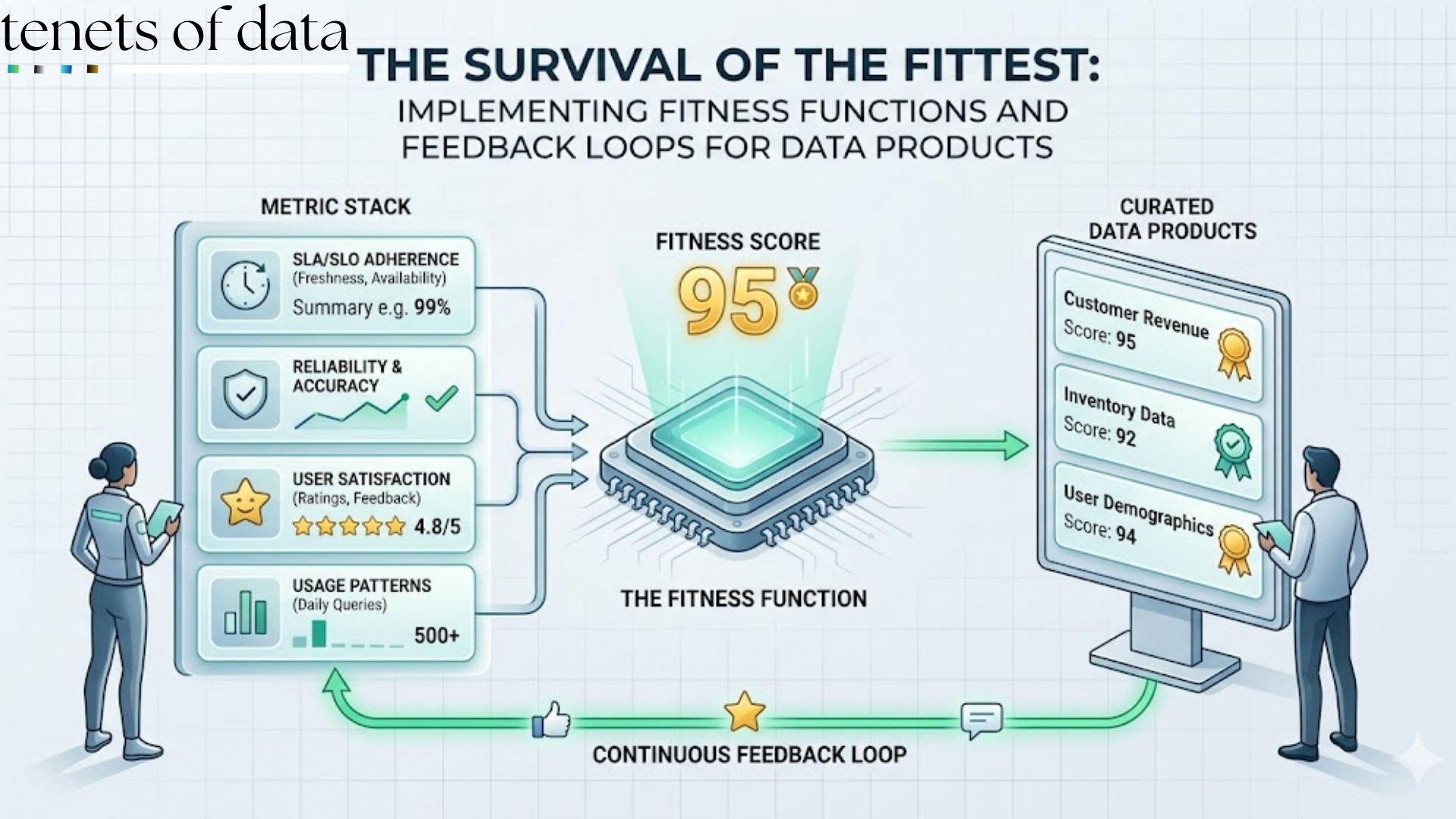
At the heart of this ranking system is the fitness function: a mathematical evaluation that objectively scores a data product based on predefined criteria. Instead of relying on anecdotal evidence of good data, the fitness function aggregates several critical data points:
- SLA and SLO Adherence: The function tracks how consistently a product meets its Service Level Agreements (SLAs) and Service Level Objectives (SLOs). This includes metrics for freshness (update frequency), availability (uptime), and completeness (lack of null values).
- Reliability and Accuracy: By analyzing historical baselines and anomaly detection logs, the system assigns quality points based on the frequency of data incidents and the time-to-resolution for errors.
- User Satisfaction and Ratings: Taking a page from consumer marketplaces, the fitness function incorporates user ratings and qualitative feedback. This Net Promoter Score (NPS) for data allows consumers to vouch for an asset's usability and trustworthiness.
- Usage Patterns: The system analyzes telemetry, including the number of daily queries, API requests, and unique consumers. High adoption rates serve as a proxy for business value and fitness within the ecosystem.
Quality-Based Visibility: Curating the Marketplace
Once these scores are calculated, they are used to operationalize quality-based visibility within the data catalog. This ensures that when a user searches for a term like customer revenue, the most trustworthy and highly-rated products appear at the top of the search results.
Producers can no longer rely on tribal knowledge to drive adoption; they must actively promote their products by maintaining high scores.
Modern data platforms now use these scores to:
- Influence Search Rankings: High-quality points lead to higher rankings during the discovery phase, connecting consumers to prime time data faster.
- Trigger Automatic Endorsements: Products that consistently exceed their SLOs can be automatically tagged as certified or recommended, providing a clear signal of trust to new users.
- Manage Product Lifecycles: The ranking system identifies underutilized or low-scoring products as candidates for deprecation and sunsetting, preventing the accumulation of zombie assets.
The Continuous Improvement Cycle
The true power of this framework lies in the feedback loop it creates between producers and consumers. When a consumer experiences a data quality issue or identifies an unmet need, they provide feedback that is captured as metadata. This feedback informs the Data Product Manager’s roadmap, triggering iterative improvements that are then reflected in the next version of the product.
This cycle transforms governance from a bureaucratic roadblock into an automated enabling layer. It ensures that the organization’s most valuable assets receive the most investment and visibility, ultimately driving higher ROI. By embedding these fitness functions into the fabric of the Data Mesh, enterprises can scale their intelligence without sacrificing the integrity of their data landscape.