Introduction
Data governance is not merely a bureaucratic set of rules; it is the operational framework of accountability, cataloging, and quality standards that defines how an organization manages its information assets. Without this foundation, AI projects invariably stall, produce hallucinatory or biased results, or worse, expose the enterprise to catastrophic regulatory and legal liabilities. When treated as a core engineering and operational discipline, data governance serves as the primary driver for three critical corporate outcomes: operational efficiency, risk mitigation, and top-line revenue growth.
1. From Manual Wrangling to Automated Pipelines
In the typical ungoverned enterprise, data scientists and analysts spend up to 80% of their time on manual data preparation, discovery, cleaning, and validation of fragmented datasets. This structural inefficiency represents a massive sink of expensive engineering hours and severely delays the time to insight.
Effective data governance eliminates this friction by treating data as a product. By establishing standardized data catalogs, clear metadata schemas, and formal data contracts, organizations can reduce the time spent on data discovery and validation by forty to sixty percent.
Data Contracts and Schema Registry
A key mechanism in modern governance is the data contract. Data contracts are formal agreements between data producers, such as software engineers building transactional databases, and data consumers, such as data platform teams and AI engineers. These contracts specify:
- The exact schema structure: Including fields, data types, and nullability constraints.
- SLA parameters: Defining update frequencies, latency thresholds, and uptime.
- Semantic definitions: Ensuring that a term like active customer has the exact same mathematical definition across all departments.
When software engineers modify an upstream application, the data contract prevents them from introducing breaking changes to downstream AI pipelines. If a schema change violates the contract, the deployment is automatically blocked in the CI/CD pipeline, saving downstream data engineering teams from hours of emergency debugging and pipeline repair.
Automated Observability and Data Quality
Instead of relying on manual audits, governed architectures employ automated data observability. Tools programmatically monitor data quality at the ingestion layer, evaluating datasets against predefined rules for completeness, uniqueness, and distribution drift.
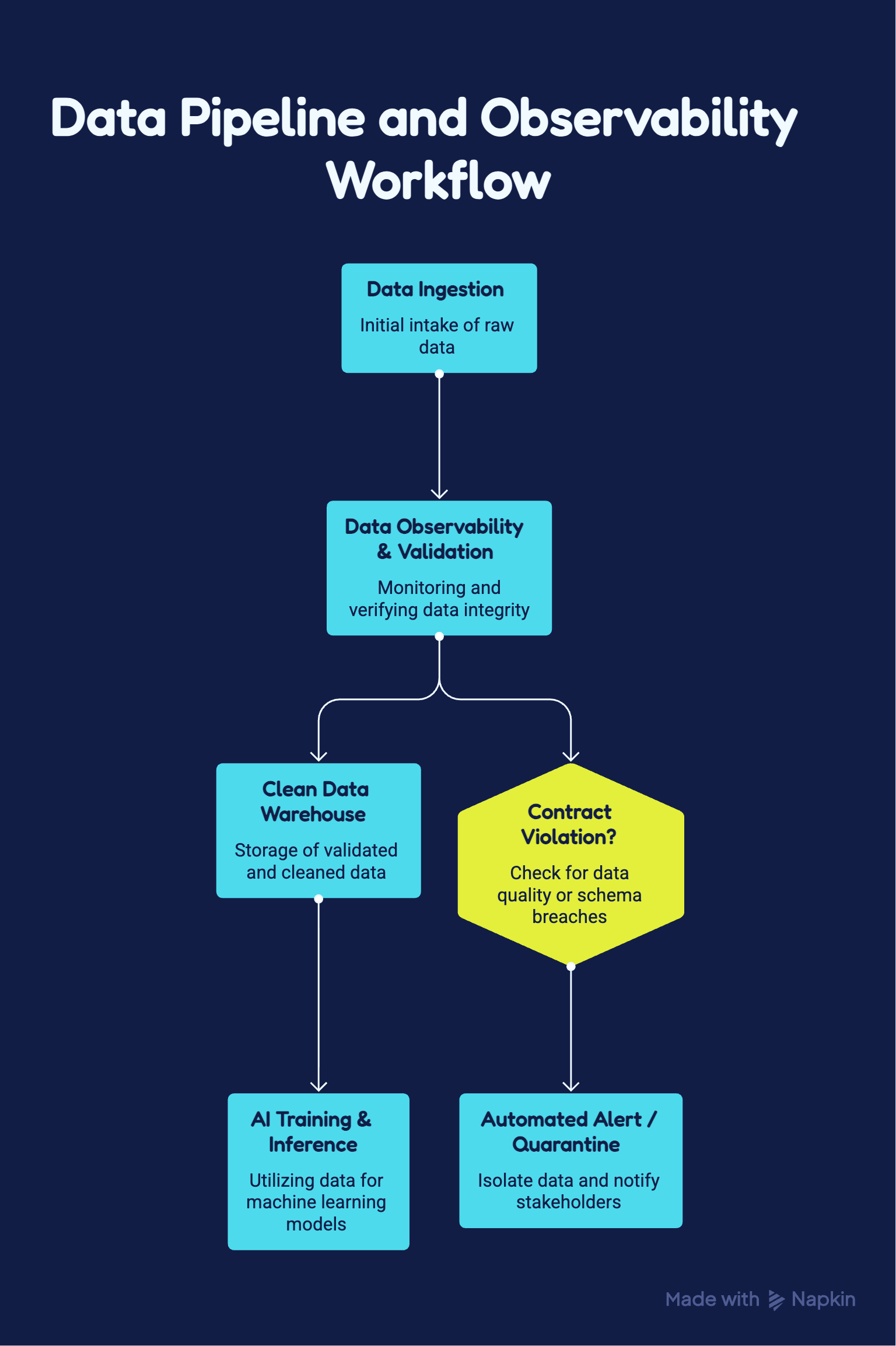
When anomalous data is detected, such as a sudden spike in null values or an unexpected shift in numerical distribution, the system quarantines the anomalous batch and alerts engineering teams before the tainted data propagates to business dashboards or retrains live machine learning models. The result is a highly resilient, self-healing data pipeline that enables rapid, reliable decision-making.
2. Building a Shield for Risk Reduction
The financial and reputational penalties of poor data management are steep. According to industry analysis, poor data quality costs organizations millions of dollars annually in operational errors, failed projects, and flawed strategic decisions. When AI models are trained on low-quality or unauthorized data, these costs scale exponentially.
In the regulatory landscape, traditional compliance mandates like GDPR, CCPA, and HIPAA are now joined by stringent AI-specific frameworks, such as the European Union AI Act. Article 10 of the EU AI Act, for instance, explicitly mandates high-quality data governance and management practices for high-risk AI systems, requiring strict oversight of training, validation, and testing datasets.
Modern Governance Security Architecture
Data governance mitigates compliance threats by implementing a multi-layered security and access architecture.
| Security Layer | Technical Mechanism | Operational Impact |
|---|---|---|
| Data Lineage Tracking | Automated metadata mapping from ingestion to consumption | Simplifies regulatory audits by proving exactly how training data was sourced and processed. |
| Role-Based Access Control (RBAC) | Access permissions mapped directly to defined organizational roles | Ensures employees only access the specific data assets required for their immediate function. |
| Attribute-Based Access Control (ABAC) | Fine-grained access based on real-time attributes like location and time | Restricts access to sensitive datasets based on contextual variables, such as user location or device type. |
| Dynamic Data Masking | Real-time obfuscation of sensitive fields (PII, PHI) | Allows developers and analysts to build models using realistic data structures without exposing actual customer identities. |
The Generative AI Imperative
The rise of large language models and generative AI introduces complex security risks that traditional security measures cannot address alone. Without governance, employees may input proprietary source code, trade secrets, or customer PII into public AI models, permanently leaking intellectual property into the public domain.
Furthermore, organizations that train their own models face the risk of data poisoning, in which malicious or highly biased data is intentionally introduced into training sets to compromise model behavior. A mature data governance framework addresses these risks by:
- Classifying all internal data assets based on sensitivity and determining which classes are permitted for model fine-tuning.
- Establishing clean, validated storage environments where only verified, pre-screened internal documents are made available to Retrieval-Augmented Generation (RAG) systems.
- Implementing strict licensing and provenance checks on all external datasets to ensure the organization has the explicit legal right to use the data for model training, shielding the enterprise from copyright litigation.
3. Unlocking Revenue Growth
While operational efficiency and risk mitigation protect the bottom line, data governance is also a powerful driver of top-line revenue. High-performing enterprises are significantly more likely to attribute their market share gains and profitability directly to investments in systematic data and analytics.
AI models are highly sensitive to the inputs they receive. In predictive analytics, a model trained on uncurated, siloed data will produce inaccurate forecasts, leading to stockouts, bloated inventory, or mispriced services. Conversely, when an organization treats data as a governed strategic asset, it unlocks the precision required to drive real-world revenue.
Feature Stores and the Acceleration of Model Delivery
In machine learning, a feature is an individual measurable property or characteristic of a phenomenon being observed. In an ungoverned environment, different data science teams repeatedly write custom SQL queries to build the same features, such as calculating customer lifetime value or 30-day transaction volume. This duplication of effort slows down model deployment and introduces logical inconsistencies across different business units.
A governed data environment utilizes a centralized feature store. The feature store acts as a curated library of pre-computed, documented, and approved features.
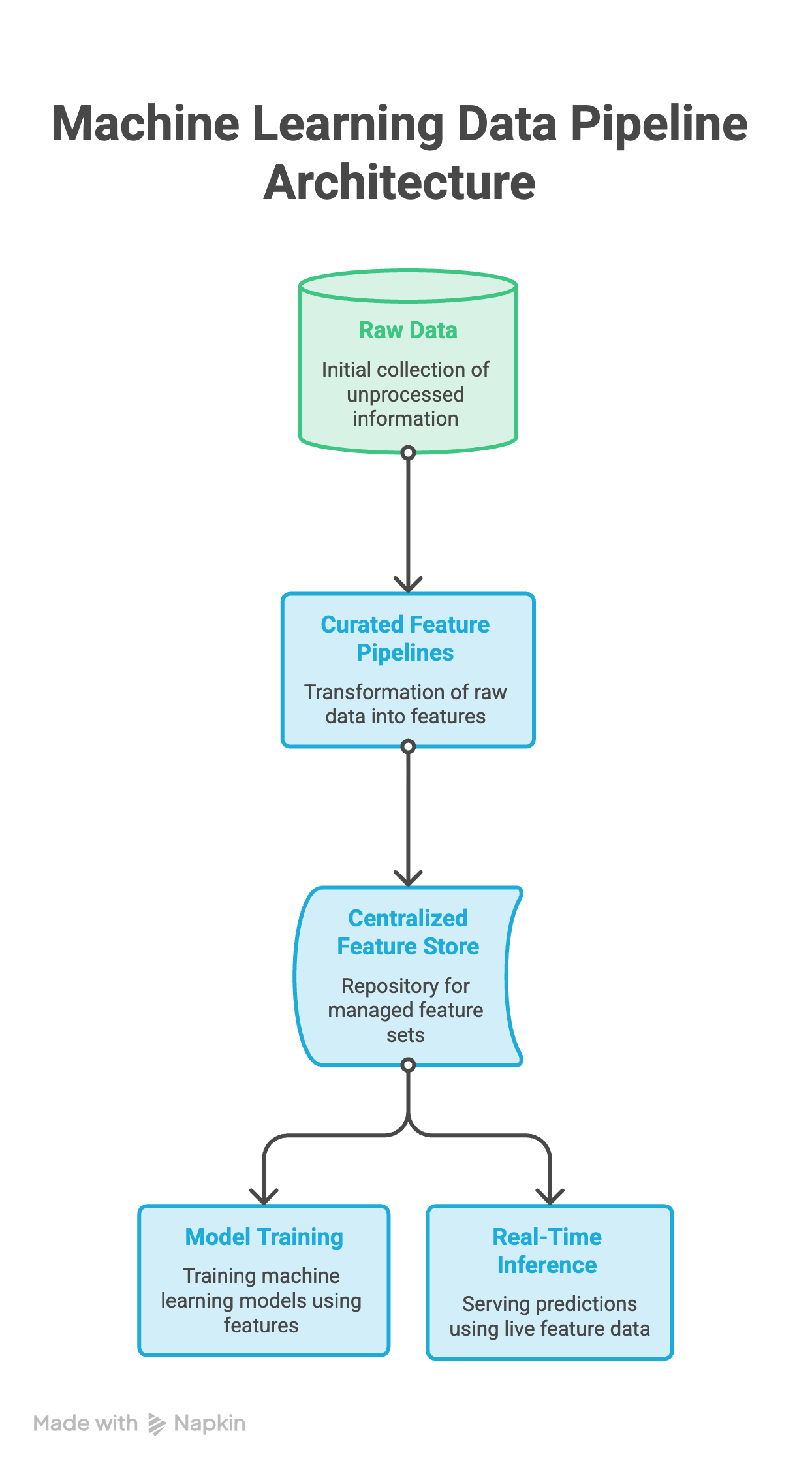
Because these features are governed, documented, and continuously updated, data science teams can pull production-ready features directly into their models. This cuts the model development lifecycle from months to days, allowing the organization to launch new products, optimize dynamic pricing models, and deploy hyper-personalized marketing campaigns ahead of competitors.
High-Fidelity Personalization and Market Expansion
True personalization requires a single, accurate view of the customer across all touchpoints, including web, mobile, physical stores, and customer support. Data governance enables this by standardizing identity resolution protocols, ensuring that interactions across disparate platforms are accurately mapped to a single golden record.
When an AI engine has access to this clean, unified customer profile, its recommendations become highly accurate. Click-through rates increase, customer churn decreases, and cross-selling campaigns achieve much higher conversion rates.
Furthermore, when an enterprise decides to expand into a new geographic market, a well-governed data architecture allows it to easily isolate regional data, apply local privacy rules, and deploy localized models with the confidence that they meet all regional compliance mandates on day one.
4. The Path to Digital Maturity
The success of any artificial intelligence initiative is fundamentally bound to the quality, structure, and accessibility of the data that feeds it. Organizations that treat data governance as an afterthought will find their AI ambitions bottlenecked by dirty data, fragile pipelines, and regulatory friction.
Conversely, companies that build a robust, modern data governance framework transform their data from a chaotic liability into a highly structured, strategic asset. By establishing clear accountability, implementing automated quality checks, and safeguarding sensitive information, these organizations build a foundation where AI can scale safely and effectively. Data governance operates behind the scenes, but its impact is clearly visible on the balance sheet, serving as the definitive differentiator between experimental technology and sustained market leadership.